Showing posts with label animals. Show all posts

Wednesday, June 10, 2015

New book by Yonassan Gershom opposes using chickens for Kapporos

Richard H. Schwartz's Foreword to 


Kapporos Then and Now:  Toward a More compassionate Tradition

by Yonassan Gershom

 Kol hakavod (kudos) to Rabbi Yonassan Gershom for writing this splendid, much needed book, arguing that Jews should practice the ritual of Kapporos using money rather than chickens.  He is the ideal person to write such a book for many reasons:

1. He is very knowledgeable on Jewish teachings, especially with regard to those about the proper treatment of animals. These include: 

Jews are to be rachmanim b’nei rachmanim (compassionate children of compassionate ancestors), emulating God, Whose compassion is over all His works (Psalms 145:9).

Compassion to animals is a test for righteousness because, as Proverbs 12:10 indicates, “The righteous person considers the life of his or her animals.” 

Compassion to animals is so important in Judaism that it is part of the Ten Commandments, which indicates that animals, as well as people, are to be permitted to rest on the Sabbath day.

A Jew must feed his or her animals before sitting down to a meal. The great Jewish heroes Moses and King David, were deemed suitable to be leaders because of their compassionate treatment of sheep during the time they were shepherds.  In short, Jews are to avoid tsa’ar ba’alei chaim, causing sorrow to animals.

2. Rabbi Gershom is a Breslov Hasid, so he is very familiar with the thinking of Hasidim about the use of chickens for Kapporos.  He is not an outsider who feels he can and should tell practitioners of Kapporos that their practice is irrational and has no redeeming positives.  He recognizes that one cannot change a traditional practice without first understanding what it is, where it came from, and what it means to the practitioners.  So he carefully explains the history of the rite and why Hasidim and other religious Jews find it meaningful.  Most importantly, he eloquently explains how the purpose of seeking compassion from God during the “Ten Days of Repentance” between the start of Rosh Hashanah and the end of Yom Kippur can better be carried out using money rather than chickens.

3.  He and his wife have long lived on a hobby farm where they raise chickens and other animals, consistent with the powerful Jewish teachings on compassion mentioned above.  Hence he is sensitive to how serious the mistreatment of chickens is, before and during the Kapporos ritual.  He explains that while initially the ritual was carried out using chickens that were raised and treated with care by the practitioners, nowadays massive numbers of chickens in cages are transported long distances by trucks, are often not given sufficient food and water, and mishandled during the ritual by people who are not used to handling chickens.   As Rabbi Gershom explains, holding chickens by the wings during the ritual is very hurtful to the birds and they only appear calm because they are playing dead, as they instinctively do when they are attacked by another animal.

4. He properly sees his role as a bridge between animal rights activists, most of whom are secular and/or non-Jewish and often act in ways that are counterproductive, and practitioners of Kapporos, who do not recognize that they are performing a custom based on transgressing Jewish teachings about compassion to animals, and thereby committing an act that is not recognized as positive in the Jewish tradition.

5.  Rabbi Gershom has a very clear, conversational style of writing, scholarly yet very readable, and he explains complex issues very well.  He is careful to put issues in context.  He is not a polemicist, but seeks common ground and solutions.  He uses examples from his own personal experience and also cites authorities.

In summary, he is the ideal person to argue that Jews should use money rather than chickens for Kapporos and he does it splendidly in this groundbreaking book.  I strongly recommend it,  hope it will be widely read, and that his message will be heeded.


Richard H. Schwartz, Ph.D.
Professor Emeritus, College of Staten Island
Associate producer of the 2007 documentary film,
A Sacred Duty:  Applying Jewish Values to Help the World

Author of:

Judaism and Vegetarianism
Judaism and Global Survival
Mathematics and Global Survival
Who Stole My Religion? Revitalizing Judaism and Applying
              Jewish Values to Help Heal Our Imperiled Planet
And over 200 articles and at JewishVeg.com/schwartz


Thursday, August 9, 2012

Rosh Hashanah L'Behamot -- the New Year for Animals

Toward a modern Jewish New Year for Animals
By Rabbi Yonassan Gershom


Rosh Hashanah, the day that we traditionally celebrate as the Jewish New Year, comes on the first and second days of the month of Tishri on the Hebrew calendar.  But in reality, there are actually four "new years" in Judaism, each serving a different purpose  (based on Talmud, Rosh Hashanah 1a, but arranged in a different order here):
  1. The first of Tishri, for the counting of calendar years, Jubilee years, etc.
  2. The first of Nissan, for dating the reign of kings and for various legal documents
  3. The fifteenth of Shevat, for tithing fruits of trees
  4. The first of Elul, for tithing cattle
Only the first of Tishri is a "New Year's Day" in the sense that we now think of it.  The others are more like fiscal years, similar, for example, to how income taxes are due on the 15th of April (in the USA) and not the first of the secular year.

The first of Elul "for tithing cattle" was the cut-off point for determining in which year an animal should be included in the count.  Animals born before that date were tithed in the old year; animals born after that date were tithed in the new year.  Nowadays very few Jews are raising flocks of animals and, since there has not been a Jerusalem Temple since the year 70 C.E. (when the Romans destroyed it), nobody is tithing animals for Temple sacrifices anymore.   Nevertheless, this date remains on the Jewish calendar, although, admittedly, it is not very well known today.
A mother hen on her nest in my yard.
(The white spot by her head is a chick.)
Very few chicks are hatched this
natural way anymore
Recently, there have been suggestions among Jewish animal welfare activists to make the first of Elul, the "Rosh Hashanah for Animals," into a day for focusing on the many teachings in Judaism about the proper treatment of animals.  This would not be the first time that a Jewish holiday got re-defined after the Temple was destroyed.  Shavuot, the "Feast of Weeks," was originally celebrated with processions of people bringing their first-fruits to the Temple.  Today it focuses on receiving the Torah at Mt. Sinai, which also took place on the same date.  Tu B'Shevat, the "New Year for Trees" (#3 in the list above) is now a form of Jewish Earth Day, when people not only plant trees, but also focus on current environmental issues.

In the same way, the New Year for Animals would shift the focus from tithing sacrifices toward learning about how animals are treated on factory farms, comparing that with Jewish teachings about the proper treatment of animals, and making choices about where we get our milk, eggs, and meat -- or maybe even considering vegetarianism as a better alternative.  Given that most Jews today are urban people who rarely, if ever, have contact with farmers or farm animals, I think that developing a modern version of this day would be a great educational opportunity.

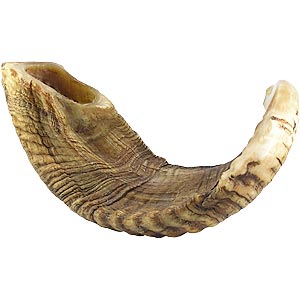
Typical ram's horn Shofar
It would also fit with the overall theme of the month of Elul.  Traditionally, we blow the shofar (ram's horn) once each morning during Elul (except on the Sabbath.)  This is to remind us that the High Holy Day season is coming, and that we should "wake up" and take account of our lives in preparation for Rosh Hashanah and Yom Kippur.  Adding the observance of Rosh Hashanah for Animals on the first of Elul would mean that on the very first day of the month leading into the High Holy Day season, we would examine how we are treating God's creatures.  Perhaps we might start with the words of the Baal Shem Tov, founder of Hasidism:

"A worm serves the Creator with all of his intelligence and ability... A person should consider himself and all creatures as comrades in the universe, for we are all created beings whose abilities are God-given."  (Tzava'as Ha Rivash 12)

(This article was reposted here with permission from Rabbi Gershom's website, Notes from a Jewish Thoreau, where you can find more essays exploring the relatonship between Judaism and nature. 

See also Richard Schwartz's article, "An Audacious Initiative to Restore the Ancient New Year for Animals" posted on August 8, 2012 on Tikkun Daily.)

Friday, May 25, 2012

Thoughts on Shavuot and vegetarianism

On Shavuot, the "Feast of Weeks" or "Feast of First Fruits," it is traditional to eat a dairy meal  rather than a meat meal.  (For those of you not familiar with the Jewish dietary laws, meat and milk are never served at the same meal.)   Two explanations are usually given for this.  The first is allegorical, comparing the Jews who had just received the Torah at Sinai to newborn babies who were not yet weaned.  The second is more practical:  The details of the dietary laws concerning animals were not yet revealed (they come later in the book of Exodus), so the people did not yet know how to properly slaughter and prepare meat.

In this day and age, we would do well on this meatless holy day to give some thought as to the issues surrounding meat-eating.   With the growing interest in vegetarianism and veganism among Jews today, let us consider this except from Richard Schwartz's new book, Who Stole My Religion?, in the chapter, "Should Jews be Animal Rights Activists?": 

------------------------

Responses to justifications for eating meat

Many apologists for the exploitation of animals seek justification in Jewish scripture, but their analysis is largely based on a misunderstanding of two important Torah verses that, when better understood, actually endorse the struggle to improve conditions for animals.  The first misunderstanding is the common claim that the Torah teaching granting humans dominion over animals (Genesis 1:26) gives us a warrant to treat them in whatever way we may wish.

That this interpretation is incorrect is demonstrated by the fact that immediately after God gave humankind dominion over animals (Genesis 1:26), God prescribed vegetarian foods as the diet best suited to humans (Genesis 1:29).  This mandate is almost immediately followed by God’s declaration that all of Creation was “very good” (Genesis 1:31). 

Adam and Eve’s original vegetarian diet was consistent with the kind and gentle stewardship that God entrusted to them and to all humankind.  Another indication of the true message of “dominion” is the Torah verse that indicates that God put Adam, the first human being, into the Garden of Eden “to work it and to guard it” (Genesis 2:15).  To guard something implies that one must protect it, not exploit it.  Based on these statements in Genesis, the Jewish sages saw human dominion as based on responsible and caring stewardship.

In support of this analysis, Rabbi Abraham Isaac Kook, Chief Rabbi of pre-state Israel and one of the outstanding Jewish thinkers of the 20th century, stated in his booklet, “A Vision of Vegetarianism and Peace”:

There can be no doubt in the mind of any intelligent person that [the Divine empowerment of humanity to derive benefit from nature] does not mean the domination of a harsh ruler, who afflicts his people and servants merely to satisfy his whim and desire, according to the crookedness of his heart. It is unthinkable that the Divine Law would impose such a decree of servitude, sealed for all eternity, upon the world of God, Who is “good to all, and Whose mercy is upon all His works” (Psalms 145:9).

The second error that the apologists for animal exploitation make is the presumption that the necessary implication of the Biblical teaching that only human beings are created “in the Divine Image” is that God places little or no value on animals. While the Torah does state that only human beings are created “in God’s Image” (Genesis 5:1), animals are also God’s creatures, possessing sensitivity and the capacity for feeling pain. So the fact that humans are in a different spiritual category than animals does not give us the right to treat animals as mere objects or machines for our pleasure.  God is concerned that they are protected and treated with compassion and justice.  In fact, the Jewish sages state that to be “created in the Divine Image” means that people have the capacity to emulate the Divine compassion for all creatures.  Rabbi Dovid Sears, in his book A Vision of Eden:  Animal Welfare and Vegetarianism in Jewish Law and Mysticism, in reference to the Talmudic teaching that we are to emulate God’s ways, states, “Compassion for all creatures, including animals, is not only God’s business; it is a virtue that we, too, must emulate.  Moreover, compassion must not be viewed as an isolated phenomenon, one of a number of religious duties in the Judaic concept of Divine service.  It is central to our entire way of life.”

In his classic work Ahavat Chesed (“The Love of Kindness”), the revered Chofetz Chaim (Rabbi Yisrael Meir Kagan of Radin) discusses this teaching at length.  He writes that whoever emulates the Divine love and compassion to all creatures “will bear the stamp of God on his person.”

Is today's meat really kosher?

The original intent of kosher slaughtering was to cause the animal as little pain as possible, as well as drain out the blood.  And indeed, studies have shown that a quick cut to the throat with a sharp knife renders the animal unconscious within seconds, before the pain sensation ever reaches the brain.  (Think back to the last time you accidentally cut yourself and did not immediately realize it.)  Even PETA has affirmed that, if done properly, kosher slaughtering is humane.  However, today’s kosher industry tends to focus only on the actual moment of slaughter, and the packing and preparation of the meat afterward.  Very little, if any, attention is paid to how the animals are treated before slaughter.
 
One has to wonder if this can be reconciled with the original intent of kashrut.  How can it still be humane if most kosher meat, dairy, and eggs now come from the same abominable factory farm conditions as does non-kosher food?   Shouldn’t we be concerned — indeed alarmed — about the ways that food is being produced?

In the past, farm animals ran free in pastures or open country, grazed on grass, and were slaughtered only for special occasions, such as when Abraham slaughtered a calf for his angelic guests. Chickens were hatched naturally under mother hens and usually eaten by Jews only on Shabbat and holidays — and then only after the birds had a life of freedom to scratch, peck, and live as a chicken was created to do.  There was nothing remotely resembling the year-round factory farm conditions under which food animals are raised today.  Therefore, although the Torah does permit eating meat, the conditions under which animals are raised today are a far cry from those used for the flocks of our ancestors...
(excerpted from Schwartz, Who Stole My Religion?, pp. 199-201)

---------------------------

Richard Schwartz then goes on to describe some of the horrific conditions in today's factory farms and the meat industry in general, coming to the conclusion that while the Torah does permit eating meat, there are many other considerations as well. "In light of the horrible conditions under which most animals are raised today," he writes, "Jews who eat meat raised under such conditions seem to be supporting a system contrary to basic Jewish principles and obligations."  Just because we can do something does not necessariy mean we should do it.  In this day and age, Schwartz says, vegetarianism is the diet most in harmony with the Torah we received at Mt. Sinai.
For more on this and other issues related to animals, vegetarianism, and the environment, download your free PDF copy of Who Stole My Religion? today.

Tuesday, February 14, 2012

"Who Stole My Religion?" is now in print -- order your copy today!

Who Stole My Religion?
Applying Jewish values to help heal our imperiled planet


Richard Schwartz, author of
"Who Stole My Religion?"

In the five decades since Richard Schwartz first became a religious Jew, he has watched the mainstream Jewish community shift more and more to the Right, often abandoning the very values that originally attracted him to Orthodox Judaism. In this soul-searching book, Schwartz examines the ways in which he believes his religion has been “stolen” by partisan politics, and offers practical suggestions for how to get Judaism back on track as a faith based on peace and compassion. Tackling such diverse issues as U.S. politics, Israeli peace issues, the misuse of the Holocaust, antisemitism, U.S. foreign policy, Islamophobia, socialism, vegetarianism, and the environmentalism, Schwartz goes where many Jews fear to go — and challenges us to re-think current issues in the light of positive Jewish values. (With photos, notes, action ideas, resource lists, and annotated bibliography. Also includes appendix materials with Rabbi Yonassan Gershom.)


About the cover design:

The background photo (#ISS028-E-020072 from the NASA files) was taken aboard the International Space Station on July 31, 2011, when the sun was just below the horizon. When observed from space, the palette of gaseous layers of our atmosphere reminds us of the fragility and tenuousness of the thin cocoon that shelters life on Earth from the cold harsh vacuum of outer space. Without this precious envelope of air, life on Earth could not exist.

A thin crescent of the new moon appears to hang above the Earth, although in reality it is more than 238,855 miles away. On the Jewish calendar, the important holiday of Rosh Hashanah, which begins the High Holy Days season of repentance, always begins on a New Moon. Perhaps the message of this photo is to encourage us to think about how we are treating our planet’s fragile atmosphere, and to change our polluting ways before it is too late.

Where to order:   

Who Stole My Religion?  is available in both print and ebook versions on Lulu.com.  Order the print copy with this button:

Support independent publishing: Buy this book on Lulu.


A FREE download of the PDF ebook version is available to readers of this blog (see link on the sidebar).  However, if you can afford it, you are encouraged to buy a download on Lulu.com for $5, to help offset Richard Schwartz's production costs in self-publishing this book.  In addition to getting your book super-fast, the PDF version has the advantage of seeing the photos in color:

Support independent publishing: Buy this e-book on Lulu.


Will there be ebook versions for Kindle, iPad and Nook?

Not unless those programs are vastly improved for handling academic works.  Epub, the program used on iPad and Nook, completely reflows the text -- which means it does not respect page numbers, indented paragraphs for long quotes, footnotes, and other academic formats.  Every time the reader changes the font size, the pages are all renumbered.   Kindle does the same thing, plus the feedback on it's handling of footnotes is horrendous!  The fact is, these new e-reader formats are mostly suitable for novels and non-fiction works with plain prose text, but just can't handle the more complex layout of  an academic work.  Until such time as the program developers solve these problems, the format best suited to Who Stole My Religion? is PDF, which preserves the original layout and can be read on your desktop or laptop computer.

Wednesday, January 4, 2012

What a wonderful path Judaism is!

What a wonderful path Judaism is!
  • Judaism proclaims a God who is the Creator of all life, Whose attributes of kindness, mercy, compassion, and justice are to serve as examples for all our actions.
  • Judaism stresses that every person is created in God’s image and therefore is of supreme value.
  • Judaism teaches that people are to be co-workers with God in preserving and improving the world. We are mandated to serve as stewards of the world’s resources to see that God’s bounties are used for the benefit of all.
  • Judaism teaches that nothing that has value may be wasted or unnecessarily destroyed.
  • Judaism stresses that we are to love other people as ourselves, to be kind to strangers, “for we were strangers in the land of Egypt,” and to act with compassion toward the homeless, the poor, the orphan, the widow, even toward enemies, and to care for all of God’s creatures.
  • Judaism urges efforts to reduce hunger.  A Jew who helps to feed a hungry person is considered, in effect, to have “fed” God.
  • Judaism mandates that we must seek and pursue peace. Great is peace, for it is one of God’s names, all God’s blessings are contained in it, it must be sought even in times of war, and it will be the Messiah’s first blessing.
  • Judaism exhorts us to pursue justice, to work for a society in which each person has the ability to obtain, through creative labor, the means to lead a dignified life.
  • Judaism teaches that God’s compassion is over all of His works, that the righteous individual considers the well being of animals, and that Jews should avoid tsa’ar ba’alei chayim, causing pain to animals.
  • Judaism stresses involvement, nonconformity, resistance to oppression and injustice, and a constant struggle against idolatry.
This ancient, marvelous Jewish outlook, applied to the planet’s gravest problems, can help shift the planet away from its present perilous course to produce a far better world.

(Excepted from Who Stole My Religion? by Richard H. Schwartz)